MoreExam
1. Question Content...
EXPLANATION
Answer: X - EXPLANATION Content.
Question1: An architect needs to plan an 802.11ac wireless upgrade for a university building. What is one reason that it is important for the architect to identify auditoriums?
Question2: An architect needs to plan a wireless deployment. The architect conducts a physical walkthrough, but still needs more information. Which significant RF obstacle can be difficult to see visually and might require access to blueprints?
Question3: Read this scenario thoroughly, and then answer each question that displays on the right side of the screen.An architect proposes these products for a customer who wants a wireless and wired upgrade:1. Aruba 2930M switches at the access layer2. Aruba 5406R switches at the core3. Aruba AP-325s4. Aruba 7205 Mobility Controllers (MCs), deployed in a cluster5. Aruba Mobility Master (MM)6. Aruba ClearPass Cx000V7. Aruba AirWareThe architect also needs to propose a security plan for the solution. The customer has 900 employees and up to 30 guests a day. The customer wants to protect the internal perimeter of the network with authentication and simple access controls. The customer is most concerned about wireless security, but also wants to ensure that only trusted users connect on the wire. However, the customer also wants all wired traffic to be forwarded locally on access layer switches. The customer already has a third-party firewall that protects the data center.The customer wants to use certificates to authenticate user devices, but is concerned about the complexity of deploying the solution. The architect should recommend a way to simplify. For the most part users connect company-issued laptops to the network. However, users can bring their own devices and connect them to the network. The customer does not know how many devices each user will connect, but expects about two or three per-user. DHCP logs indicate that the network supports a maximum of 2800 devices.Refer to the provided scenario. Based on the plan for wired authentication, what is a correct plan for wired user VLANs?
Question4: An architect plans 128 APs to support 12,800 devices in a very high density (VHD) design. The customer requires high availability, so the architect plans to recommend a pair of controllers. What is one reason to recommend 7210 controllers rather than 7205 controllers for this deployment?
Question5: An architect needs to deliver an upgrade to an 802.11ac-based solution for a customer. The customer requires an active site survey for the new deployment. Which deliverable should the architect provide to the customer?
Question6: An architect proposes Aruba 2930F switches, which do not have OOBM ports. The customer wants to follow best practices for network management security. Which guideline can the architect follow?
Question7: A customer needs an 802.11ac upgrade for an office with cubicles. The customer states that, because they planned locations for the existing 802.11n APs so that there are no coverage holes, they will simply deploy the new 802.11ac APs in the same location as the existing APs. The customer plans to support mobile devices in addition to laptops.What should the architect explain about shy a site survey is desirable to determine the optimal locations for the new APs?
Question8: A plan includes these security settings for the employee WLAN:1. WPA2-Enterprise with AES encryption2. 802.1X with PEAP-MSCHAPv2However, the customer wants to use certificates to authenticate user devices. Which change brings the plan in alignment with the customer requirements?
Question9: An enterprise needs an upgrade to 802.11ac. Users run applications such as Web, email, voice, and video. The architect needs to conduct an active site survey to plan 802.11ac AP locations. The noise floor is about -90 dBm across the site.Based on Aruba best practices, what is the minimum acceptable signal that the architect should look for to determine the test AP range?
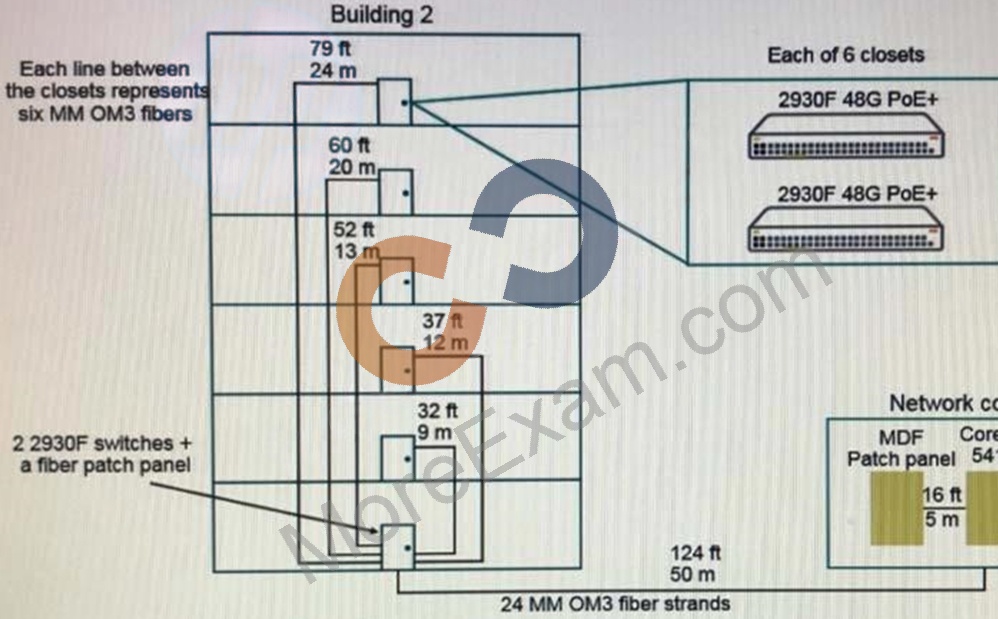
Question10: Refer to the exhibit.Exhibit 1.Exhibit 2.Exhibit 1 shows the logical plan, and Exhibit 2 shows the BOM that the administrator has made in Iris.What is missing from the IRIS BOM?
Question11: For which scenario does the Aruba backplane stacking technology meet the needs?
Question12: What should an architect use as a guideline to determine when to define another VLAN for wireless devices?
Question13: A customer requires high availability for wireless services, including stateful failover for user connections if the Mobility Controller (MC) that handles the user traffic fails. What is the requirement for the design?
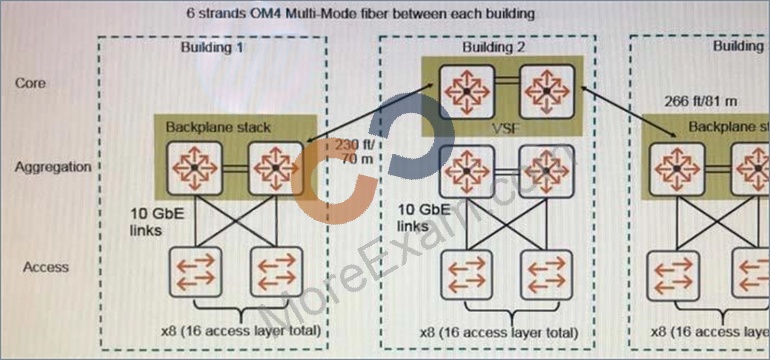
Question14: Refer to the exhibit.The exhibit shows the current plan for a wired network upgrade.As much as possible, the customer wants to flatten the architecture and avoid recabling. However, each Building 2 switch must also maintain connectivity to the core if one link fails. What should the architect propose to meet the customer requirements?
Question15: Refer to the exhibit.An architect selects 5406R switches for the aggregation layer. What is an appropriate amount of bandwidth for the link aggregation between each aggregation layer VSF fabric and the campus core?
Question16: An architect proposes an Aruba wireless solution for a customer that uses Microsoft Skype for Business.What should be set up on the MCs, or MM, to ensure that wireless voice traffic is properly prioritized?
Question17: What is one important guideline for antenna selection?
Question18: A customer has a small office building that needs approximately 32 APs. The solution must support basic rogue AP detection and provide a stateful firewall with role-based policies. The customer would like the simplest, most cost-effective deployment that meets their needs.What should the architect recommend?
Question19: Refer to the exhibit.The customer needs to expand its wired and wireless network to a new building, Building 2, which is near the existing building, Building 1. The exhibit shows the logical plan that the architect has created so far.The aggregation layer switches in the new building should provide the default gateway services for the VLANs in the new building and route traffic to the core. The existing Aruba Mobility Controllers (MCs) will control the new APs.What should be the VLAN assignment for Link 1, indicated in the exhibit?
Question20: Refer to the exhibit.What is one reason for an architect to recommend the use of Virtual Switching Framework (VSF) in this network?
Question21: Read this scenario thoroughly, and then answer each question that displays on the right side of the screen.An architect proposes these products for a customer who wants a wireless and wired upgrade:1. Aruba 2930M switches at the access layer2. Aruba 5406R switches at the core3. Aruba AP-325s4. Aruba 7205 Mobility Controllers (MCs), deployed in a cluster5. Aruba Mobility Master (MM)6. Aruba ClearPass Cx000V7. Aruba AirWareThe architect also needs to propose a security plan for the solution. The customer has 900 employees and up to 30 guests a day. The customer wants to protect the internal perimeter of the network with authentication and simple access controls. The customer is most concerned about wireless security, but also wants to ensure that only trusted users connect on the wire. However, the customer also wants all wired traffic to be forwarded locally on access layer switches. The customer already has a third-party firewall that protects the data center.The customer wants to use certificates to authenticate user devices, but is concerned about the complexity of deploying the solution. The architect should recommend a way to simplify. For the most part users connect company-issued laptops to the network. However, users can bring their own devices and connect them to the network. The customer does not know how many devices each user will connect, but expects about two or three per-user. DHCP logs indicate that the network supports a maximum of 2800 devices.Refer to the provided scenario.Which solution should the architect recommend on the 2930M switches to authenticate and control wired employee devices?
Question22: A customer requires a wireless upgrade. The architect proposes:Aruba AP-325sMobility Controller (MC) 7210sVirtual Mobility Masters (MMs)ClearPassAirWaveThe customer is interested in wired authentication, as well as wireless authentication, but does not have the budget to upgrade the wired network. The wired network does not currently support 802.1X or RADIUS.Which feature of the Aruba solution should the architect explain to justify the proposed solution?
Question23: An architect needs to choose between an Aruba Mobility Controller (MC) 7010 or 7024. Which сcustomer need indicates that the 7024 is a better choice than the 7010?
Question24: A customer has very high availability requirements for wireless services. The architect plans to implement clustering on several Aruba Mobility Controllers (MCs). Which benefit of this feature should the architect explain?
Question25: An RF plan specifies wide sector directional antennas.Refer to the antenna specifications.H-plane refers to the Azimuth or Horizontal plane and E-plane refers to Elevation or Vertical plane.Antenna 1: H-plane = 360; E-plane = 120Antenna 2: H-plane = 360; E-plane = 60Antenna 3: H-plane = 100; E-plane = 90Antenna 4: H-plane = 60; E-plane = 60Which antenna specifications indicate that the antenna is a good choice for the plan?
Question26: Read this scenario thoroughly, and then answer each question that displays on the right side of the screen.An architect proposes these products for a customer who wants a wireless and wired upgrade:1. Aruba 2930M switches at the access layer2. Aruba 5406R switches at the core3. Aruba AP-325s4. Aruba 7205 Mobility Controllers (MCs), deployed in a cluster5. Aruba Mobility Master (MM)6. Aruba ClearPass Cx000V7. Aruba AirWareThe architect also needs to propose a security plan for the solution. The customer has 900 employees and up to 30 guests a day. The customer wants to protect the internal perimeter of the network with authentication and simple access controls. The customer is most concerned about wireless security, but also wants to ensure that only trusted users connect on the wire. However, the customer also wants all wired traffic to be forwarded locally on access layer switches. The customer already has a third-party firewall that protects the data center.The customer wants to use certificates to authenticate user devices, but is concerned about the complexity of deploying the solution. The architect should recommend a way to simplify. For the most part users connect company-issued laptops to the network. However, users can bring their own devices and connect them to the network. The customer does not know how many devices each user will connect, but expects about two or three per-user. DHCP logs indicate that the network supports a maximum of 2800 devices.Refer to the provided scenario. Which ClearPass licenses should the architect include in the proposal?
Question27: Refer to the exhibit.An architect determines that 80 Gbps bandwidth is required for the link aggregation between the Building1aggregation layer and Building 2. Which transceivers should the architect recommend for each pair of switches?
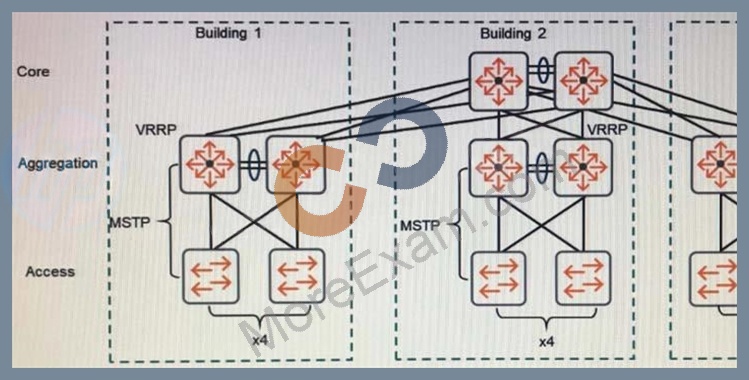
Question28: Refer to the exhibit.A customer wants to replace the core and aggregation layer of an existing network. Currently the network routes between the aggregation layer and core, and uses the technologies shown in the exhibit.The customer now wants to route at the core, instead of the aggregation layer, and extend some of the same VLANs in different buildings. However, the customer cannot eliminate the aggregation layer at this point. What should the architect recommend?
Question29: Refer to the exhibit.The customer requires fast failover if any one link or core device fails. Which additional technology should the architect plan on the core VSF fabric to meet these criteria?
Question30: An architect needs to plan 802.11ac wireless deployment for an office environment with a mix of closed offices and cubicles. The coverage area is approximately 4,645 square meters (approximately 50,000 square feet) and has 350 users. The employees use the wireless network for typical office applications, such as email, Web, printing, and accessing shared files and datacenter services.The architect plans to do a predictive site survey and use VisualRF to plan the coverage. What is a general estimate for the AP count that the architect should have in mind?
Question31: An Aruba wireless solution for a very high density (VHD) wireless solution consists of a Mobility Master (MM) and two Mobility Controllers (MCs). What is the best practice design for routing the wireless traffic?
Question32: A customer needs a wired network solution that can recognize and prioritize a wide array of different types of traffic, including casual Web browsing, voice, video, SAP Online, and file sharing.The architect needs to choose between the Aruba 2930F or the 2540 Switch Series for the access layer switch. Why would the architect choose the 2930F rather than the 2540 Switch Series for this customer?
Question33: A customer has several clusters of Aruba 325 Instant APs. The customer is happy with the performance of the current APs, but would like to add a Mobility Controller (MC). What should the architect propose?
Question34: A customer needs a wireless solution upgrade. Among the devices that need wireless access are printers.What information about the printers does the architect need to plan the wireless solution? (Select two.)
Question35: An architect needs to plan a very high density (VHD) wireless network at a large events venue, at which thousands of attendees are expected. The architect plans to deploy a cluster of Mobility Controllers (MCs) to control the APs. It is important to support seamless roaming for wireless devise across the venue.What should the architect ensure for the network services?